Open any pricing page in the home-service software category and you will find one number doing all the work. $29 a month. $149 a month. $399 a month. That number has one job, which is getting you to sign up. What it cannot do is predict your bill six months from now, once the stack is fully assembled and doing the things you actually bought it for.
We maintain a comparison library of the tools service businesses run on, and we re-verify the pricing on a schedule. The pattern holds across every vendor we have audited. The advertised price is the entry fee. The working configuration costs more, sometimes double. And the largest cost in the stack never appears on an invoice at all.
The sticker price is a starting bid
This is not a scam. It is a pricing architecture, and once you see it you cannot unsee it.
Software vendors compete on the headline number, so the headline number has to stay small. The way to keep it small is to move everything that is not core out of the base plan. In field service software, core means quoting, scheduling, and invoicing. Everything that touches growth, meaning the leads, the follow-up, the reviews, the missed calls, migrates to a second menu.
So the base plan is real, and it does what it says. It just does not do the part of the job you probably bought it for. That part is sold separately, one add-on at a time, each priced low enough that no single line feels worth a fight.
The result is a bill nobody designed and nobody approved in one sitting. It accreted.
The math on a real five-person crew
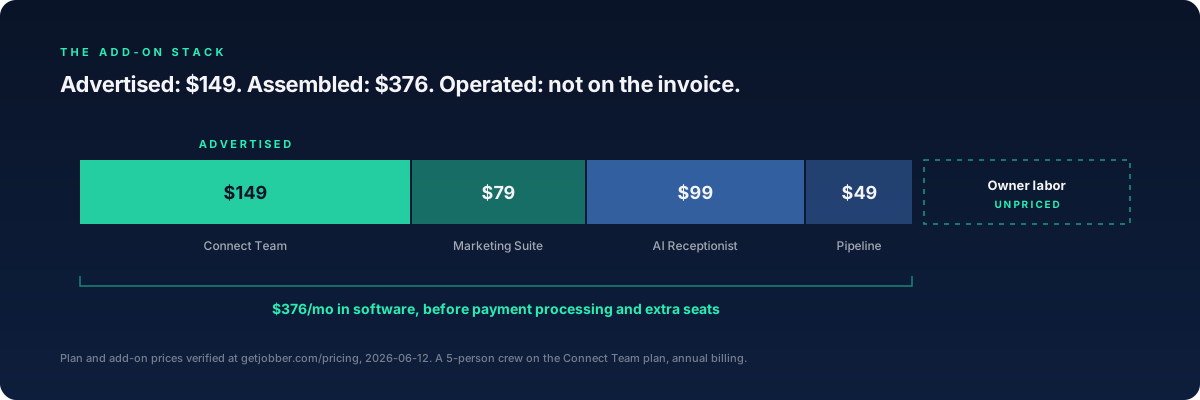
Here is what that looks like with live numbers. Jobber's Connect Team plan runs $149 per month on annual billing and includes five users (getjobber.com/pricing, verified 2026-06-12). For a five-person crew, that is the honest sticker price, and Jobber, to its credit, publishes it.
Now walk through what a crew that wants the growth side covered actually adds:
- Marketing Suite, $79 per month. Review requests, email campaigns, referrals, and a one-page template site.
- AI Receptionist, $99 per month. Answers the calls and texts you miss.
- Pipeline, $49 per month. Lead tracking, so inquiries stop vanishing between the inbox and the calendar.
That is $376 per month, with plan and add-on prices verified at getjobber.com/pricing on 2026-06-12. Two and a half times the advertised number, before payment processing takes its cut at 2.9% plus 30 cents per card transaction.
And the stack keeps growing on a second axis: seats. Additional users run a reported $29 per user per month, and reviewers cite per-user creep past $500 a month as the top stated reason for leaving (Trustpilot reviewer, October 2025, via fieldcamp.ai).
None of this makes Jobber a bad product. It has the best-rated mobile app in its category and genuinely clean quoting and invoicing, and we say so in our full Jobber breakdown. The point is not the vendor. The point is the architecture. $149 was never the price. $149 was the door.
Same shape, different logo
Run the same exercise anywhere in the category and the curve looks identical.
Podium's Core plan is reported at $399 per month for a single location on an annual contract. Podium does not publish pricing, so the figures come from RepliFast's teardown dated January 2026. By the time the AI Employee add-on, AI review replies, extra users, and carrier fees stack on top, the same teardown puts the realistic single-location total at a reported $500 to $800 per month.
Housecall Pro publishes its tiers, $59 to $299 per month on annual billing, but third-party teardowns estimate real total cost of ownership lands 20 to 40 percent above sticker once add-ons and processing are counted (reported, costbench.com and rivetops.io).
Three vendors, three sticker strategies, one outcome: the working price is not the advertised price. We keep every one of these figures sourced and dated in our comparison hub, because we have yet to find a vendor where the sticker survived contact with a real configuration.
The line item nobody bills
Now add the cost that never reaches an invoice: somebody has to operate all of it.
The Marketing Suite sends review requests, but you write every reply. Pipeline shows you the leads, but someone has to work them. The AI Receptionist answers the missed call, but the lead who goes quiet after the first text still needs chasing, and no add-on chases. The reports generate themselves; reading them, and changing something because of them, is a human job. At a five-person company, that human is almost always the owner.
Put a number on it, your own number. If operating the stack takes five hours of owner time a week, and an owner hour spent estimating and closing is worth $150 to the business, that is roughly $3,000 a month of operating labor sitting on top of a $376 software bill. The software was never the expensive part. The operator is.
And the labor is the optimistic case. The pessimistic case is the stack half-operated: review replies skipped, Pipeline checked weekly instead of hourly, follow-up that stops after one text. The market data on what that costs is blunt. Industry studies have found that leads contacted within five minutes are about nine times more likely to convert, and the typical service business loses $10K to $50K a year to inquiries that came in and never got worked. A tool that surfaces the work does not do the work. The gap between the two is where that money goes; we traced one version of it in our missed-call follow-up breakdown.
The most expensive line in your software stack is the one no vendor will ever bill you for: the owner, operating all of it.
The question that changes the answer
"Which tool is cheapest" is the question pricing pages are built to win. It compares stickers, and stickers are fiction by month six.
The real total is software, plus add-ons, plus processing, plus the owner hours that make any of it function, plus the leads that leak whenever those hours run out. Price that whole column and the question shifts to the one that actually matters: who does the work?
If the answer is "the owner does," then every stack you evaluate should carry your own hours on the bill. If the answer is "nobody, reliably," then the cheapest stack is the most expensive thing you own.
That second question is the one DECO is built to answer differently. DECO is not another tool on the menu. It is an installed, operated system: AI agents with a human team behind them that answer every inbound lead instantly, in seconds, qualify in about 90 seconds, book the appointment, run the follow-up, request the reviews, and walk you through what the numbers mean. The pricing is flat and published on our plans page: Foundation Install at $297 per month, AI Employee at $597 per month, Automation Engine at $997 per month. No per-seat math, and the operating labor is not an add-on. It is the product.
Your field software can stay. DECO runs the front office, with estimates, invoicing, payments, and e-sign part of the operated system, and connects to your dispatch, job costing, and payroll rather than replacing them, so crews that like Jobber keep Jobber for the field work. Prefer to consolidate? DECO builds around what you use, or replaces it when the tool is the real bottleneck. You choose.
The next time a pricing page shows you one clean number, do the six-month math before you sign. Add the second menu. Add the seats. Add the processing. Then add the hours, yours, that turn the stack from a subscription into a system. The advertised price was never the cost. The cost is whoever does the work.
Keep reading

Comparisons
Jobber vs HubSpot vs ServiceTitan vs GHL: which fits a $1-5M service business
10 min readThe DECO Team