Most service businesses we talk to spent forty hours evaluating CRM and operations platforms. They demoed three or four tools, watched a hundred webinars, read every comparison article on page one of Google, and still picked the wrong one. Twelve months later the team is half-onboarded, the data is in three places, and nobody trusts the dashboards.
The pattern is so consistent that we now open every discovery call with the same question: what platforms have you tried, and why did you stop using them. Almost nobody picks badly because the platform is bad. They pick badly because they are evaluating the wrong dimension.
This post is the framework we use internally when a client asks us which platform to standardize on. It compares the four tools we see most often: GoHighLevel, HubSpot, ServiceTitan, and Jobber. It is intentionally honest about where each one wins and where each one falls apart.
The five capabilities that actually matter
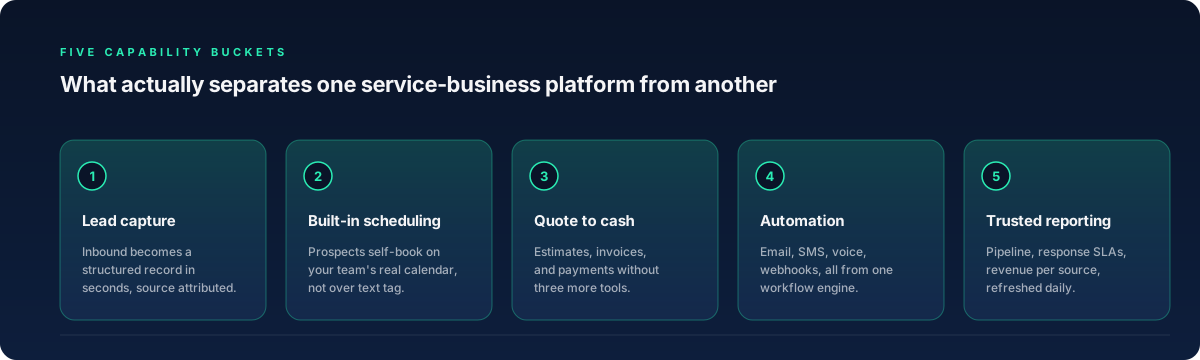
Forget feature checklists. For a $1–5M service business, exactly five capabilities determine whether a platform pays back the investment:
- Lead capture. How fast does a new inbound lead become a structured record in your system, with source attribution intact, before any human touches it.
- Built-in scheduling. Can a prospect self-book on your team's real calendar, or are you still manually offering three time slots over text.
- Estimates, invoicing, and payments. Quote to cash without bouncing through three tools.
- Multi-channel automation. Email, SMS, voice drops, and webhook orchestration, all coordinated from one workflow engine.
- Reporting that an operator trusts. Pipeline stage progression, response-time SLAs, and revenue per source, refreshed at least daily.
Every other feature is either a nice-to-have or a distraction. If a platform forces you to bolt on a second tool to cover one of these five, the integration tax usually exceeds the platform's monthly cost within the first quarter.
GoHighLevel (GHL)
Best for: marketing-first service businesses where the founder is also the marketer, agency-managed accounts, and operators who want every channel in one workflow engine.
GHL is unusual in this list because it was built for marketing agencies, not directly for end operators. That history shows up everywhere. The form builder, calendar, SMS, email, and pipeline are tightly integrated. Workflows can branch on twelve conditions and fire across SMS, email, voice, and webhook in the same sequence. The tradeoff is that the UI does not coddle you. The first time a non-technical operator tries to build a workflow, they hit a wall.
Where GHL wins: the breadth of channels in one workspace and the cost. A single GHL location can replace five tools that would otherwise cost three or four times more.
Where it falls short: native estimates and invoicing are functional but plain. Payment reconciliation requires Stripe or external bookkeeping. Field-team workflows (route optimization, technician dispatch) are not in the box. And reporting depth lags behind purpose-built CRMs once your pipeline gets above a few hundred deals.
HubSpot
Best for: B2B service businesses with longer sales cycles, complex multi-stakeholder deals, and a real sales team to operate the pipeline.
HubSpot is the cleanest pipeline UX in this list. Sales reps actually want to use it, which matters more than every other feature combined. The reporting is mature, the integrations marketplace is the deepest, and the email automation is the most reliable.
Where it wins: pipeline management, contact intelligence, and the moment your team grows past two reps.
Where it falls short: the price ladder is brutal. The tier most service businesses actually need (Sales Hub Professional plus Marketing Hub Professional) is three to four times the cost of GHL for comparable surface area. Service-business primitives like estimates, invoices, and field scheduling are not native. You will end up running HubSpot alongside Jobber or QuickBooks, not instead of them. And the customization that makes HubSpot powerful for B2B SaaS becomes overkill for a thirty-deal-a-month residential service operator.
ServiceTitan
Best for: $5M+ home services operators (HVAC, plumbing, electrical, roofing) with field teams of ten or more.
ServiceTitan is the deepest, most opinionated platform in this list. It was built for trade contractors and it shows. Dispatch board, technician routing, financing integrations, equipment history per address, recurring service agreements, and an entire layer of accounting are all native and tuned for the work.
Where it wins: if you run a field-service trade business at meaningful scale, no other platform comes close to the operational depth.
Where it falls short: it is expensive, the implementation is heavy, and the platform assumes you have an operations manager whose full-time job is to run it. We have watched several $1M businesses sign up, bog down in the implementation for nine months, and never get full ROI before they cancel. The floor for value is genuinely around $3-5M in revenue with an existing field team. Below that, you are paying enterprise pricing for a system you cannot fully operate.
The platforms are not the problem. The problem is that platforms do not run themselves, and most service businesses do not have the bandwidth to run another tool on top of doing the work.
Jobber
Best for: $200K–$2M field-service businesses (cleaning, lawn care, painting, handyman) where the founder is still the dispatcher and the team is under fifteen people.
Jobber is the polite sibling in this list. The product is opinionated in a small-business-friendly way: clear UI, mobile-first for technicians, the right defaults for quoting and invoicing a service job, and a learning curve a new admin can handle in a week.
Where it wins: time to first value. A small operator can be quoting and invoicing through Jobber within a few hours of signing up.
Where it falls short: lead capture and pipeline reporting are thin. Marketing automation is essentially nonexistent. Once you cross around $2M in revenue or grow past fifteen technicians, the reporting layer stops giving you the visibility you need to make pricing and capacity decisions. The platform also does not have the workflow depth to run multi-channel nurture sequences.
Jobber vs HubSpot, head to head
More operators search for this exact matchup than any other pairing in this post, which is interesting because the two tools barely compete. They answer different questions. Jobber manages jobs: the quote, the visit, the invoice, the crew on site. HubSpot manages a pipeline: the contact, the deal, the follow-up sequence, the forecast. If you feel torn between them, the real question is which half of your business is leaking more this quarter.
Pick Jobber over HubSpot when your work is field visits with a defined scope, your team quotes and invoices every day, and a sale closes in hours or days. In that business HubSpot feels like an empty office tower: impressive, expensive, and mostly unused floors.
Pick HubSpot over Jobber when you sell B2B contracts or consultative projects, deals take weeks and several conversations, and more than one person touches a deal before it closes. Jobber has no real concept of that motion. Deals do not progress in Jobber, they sit.
If the honest answer is that both halves leak, resist buying both on day one. Two half-operated platforms leak more than one well-operated platform. Fix the half that is costing more jobs right now, get it actually operated, and revisit the other half in six months.
How to actually pick
The picking question is not "which platform has the best features." It is two questions stacked together:
Question one: which tier of operational maturity are you at right now?
- Under $1M, owner-operated: Jobber. Get billing right. Worry about the rest later.
- $1M–$3M, marketing-led, no field team: GHL. The breadth lets you consolidate.
- $1M–$5M, B2B or consultative: HubSpot. Pay the price for the pipeline UX and reporting depth.
- $3M+ field services trade: ServiceTitan. Nothing else covers the work.
Question two: who is going to actually operate this thing?
This is where most evaluations break. Every platform on this list is operated by humans who plan workflows, build forms, write nurture sequences, watch dashboards, and clean data. If you do not have someone whose job description includes those tasks, you have not picked a CRM. You have bought another login.
This is the gap that drives most platform regret. The owner picks the platform, signs the contract, and then nobody has the bandwidth to actually run it. Six months later the system is half-implemented and the data is unreliable.
Questions operators ask
Is Jobber a CRM?
Only in the lightest sense. Jobber stores customers and job history, but it is built around scheduling and billing field work, not around moving deals through stages or running multi-touch follow-up. If pipeline management is the gap you are trying to close, Jobber alone will not close it.
Can HubSpot replace Jobber?
Not for field work. HubSpot has no dispatching, no technician mobile app, and its quoting is built for proposals, not same-day service visits. Businesses that try usually end up rebuilding job management in spreadsheets within a quarter.
Do I need both?
Run both only when two things are true at once: a real sales team works consultative B2B deals, and crews deliver field work daily. Below roughly $2M in revenue that split rarely exists, and paying for two platforms means operating two platforms. Most operators at that stage are better served picking one and running it well.
What about GoHighLevel instead of either?
GHL does not replace Jobber's field operations, and it is not trying to be HubSpot's enterprise pipeline. What it covers is the growth layer: capture, follow-up, booking, and reviews across every channel, at a cost most service businesses accept. The pairing we install most often is a field platform for the work plus GHL for the growth layer, run as one system.
What we tell our own clients
DECO operates as the team that runs the platform, not as another platform. Our installed Growth Operating System is built on top of GoHighLevel for most service businesses we work with, because GHL hits the cost-and-breadth sweet spot for the $1–5M range. But the platform is the smaller part of the work. The larger part is the workflows, the response-time SLAs, the nurture sequences, the data hygiene, and the weekly review cadence that makes the platform actually generate revenue.
If you read all four sections above and your honest answer to "who will operate this" is "nobody yet, and we are too busy to learn it ourselves," that is the most useful diagnostic outcome of this post. The platform decision is downstream of that answer, not upstream.
You can read our breakdown of what we install across all five operational pillars, see the comparison table at the top of /plans for the short version, or go deeper in the comparison hub. If your evaluation is between the two small-business defaults, we also wrote a dedicated head-to-head on Jobber vs Housecall Pro. And if you want to see the full Field Notes archive, including the post on why hiring another salesperson rarely fixes a revenue plateau, it is all on /blog.
Keep reading