
Ask a roomful of service business owners what they could automate and the lists run long. Ask what they should automate first and the room goes quiet. Sequencing is the part nobody writes down, and it is where most automation projects stall: the owner buys tooling, wires up whatever workflow looked easiest, sees no revenue change in 60 days, and concludes automation does not work in their trade.
It works. It just has an order of operations, and the order matters more than the tooling.
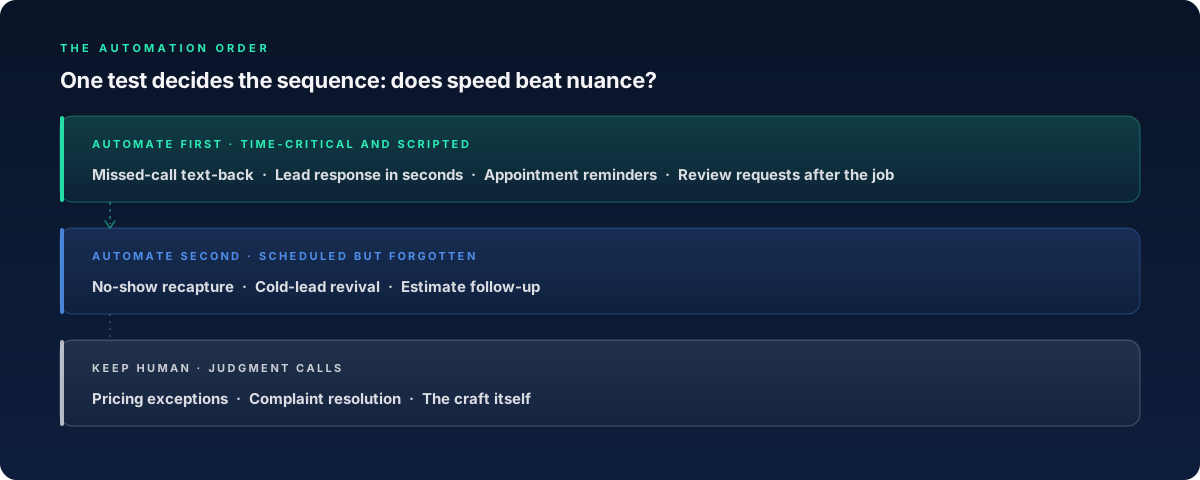
We install and operate growth systems for US home-service businesses, and every engagement gets sequenced the same way. First, the moments that are time-critical and fully scripted. Second, the tasks that are scheduled but chronically forgotten. And some work we deliberately never automate: the judgment calls. Here is the playbook, including the one-question test that decides every case.
The test: does speed beat nuance here?
For any task in the business, ask one question. If this happened a hundred times faster but with slightly less nuance, would the outcome improve?
For a missed call, yes, overwhelmingly. The prospect does not want a thoughtful reply in three hours. They want a competent reply in seconds, because they are already dialing the next company on their list. The lead-response research cited across the industry puts hard numbers on it: leads contacted within five minutes convert up to nine times more often, and responding inside that window saves an estimated 30 to 40 percent of leads that would otherwise go dark. Those are market statistics, not ours, but the data from the businesses we operate points the same direction.
For an unhappy customer whose brand-new floor has a gap at the threshold, no. Speed without nuance makes that conversation worse. That customer needs a human who can listen, own the mistake, and decide what making it right is worth.
Speed-beats-nuance work gets automated. Nuance-beats-speed work stays human. Everything below is that test applied across a service business, in the order we install it.
Automate first: the time-critical and scripted
Four workflows go in first, every time. Each one runs on a clock where every minute of delay has a measurable cost, and each one uses the same words in every instance. Time pressure plus a fixed script is precisely the work machines are built for.
Missed-call text-back. Between a third and half of inbound calls to service businesses ring out, and most of those callers never hear back. We traced the full damage in the hidden cost of missed-call follow-up, but the short version is that the caller is often talking to your competitor within ten minutes. The fix is a text that fires the moment the call is missed: it names your business, apologizes for missing them, and asks the first qualifying question. No nuance required. Enormous speed required.
Lead response on forms and messages. A web form submitted at 9 PM should get an answer at 9 PM, not at 8 the next morning. In the systems we run, the first response goes out instantly, within seconds, and a short qualification exchange covering job type, location, and timeline wraps in about 90 seconds. The prospect feels handled. The owner wakes up to a booked estimate instead of a cold email address.
Appointment reminders. One reminder at 24 hours, another at 2 hours, with confirm and reschedule options built into both. The message never varies, the timing never slips, and the no-show rate drops the first week it runs.
Review requests after job completion. Satisfaction peaks the day the work is finished and decays from there, so the request has to land within hours, not whenever someone remembers at month end. The ask is identical for every customer, which makes it perfectly scriptable, and the compounding effect on local search is one of the cheapest growth levers a service business has.
Run the math on a business missing all four and the leak is rarely small. Across the companies we audit, slow or absent follow-up typically costs $10,000 to $50,000 a year in lost lead value. That figure is why this tier goes first: it pays for everything that comes after.
Automate second: the scheduled but forgotten
Tier two is different. Nothing here is urgent in any given minute, which is exactly why none of it happens. No owner decides to skip estimate follow-up. It loses to whatever is on fire today, every day, until the pipeline quietly thins out.
No-show recapture. A no-show is not a dead appointment. It is an unworked one. A same-day sequence, a text within the hour, a call task for the afternoon, an offer of two specific new slots, recaptures around 70 percent of no-shows in the systems we operate. Without a sequence, the typical no-show is never contacted again.
Cold-lead revival. Every service business sits on a list of leads from the past 6 to 18 months who said not right now and were never spoken to again. A structured revival campaign, run on a calendar instead of a memory, reactivates 25 to 35 percent of them in our installs. It is usually the cheapest revenue in the entire business, because the acquisition cost was already paid once.
Estimate follow-up. Most operators send the quote and wait. A fixed cadence on day 1, day 3, day 7, and day 14, with escalating directness, closes deals that were never lost, only forgotten.
The defining trait of this tier is consistency, not speed. These messages do not have to land in seconds. They have to land every single time, and humans are reliably bad at every single time.
Automate where speed beats nuance. Keep humans where nuance beats speed. Most failed automation projects are that test applied backwards.
Keep human: the judgment calls
Three categories stay human in every system we build, not because technology cannot touch them, but because nuance is the entire value.
Pricing exceptions. The standard quote can and should be templated. The decision to discount for a fifteen-year customer, to price up a brutal access situation, or to walk away from a bad-fit job is margin judgment. Margin judgment is the owner's actual job, and no script survives contact with a genuinely unusual project.
Complaint resolution. An automated acknowledgment is fine and useful: we received your message, the owner will call you within the hour. The resolution itself never is. A complaint is a relationship standing at a fork, and the difference between a refund plus a one-star review and a customer for life is almost always how human the response felt.
The craft. The estimate walkthrough, the workmanship, the judgment about what the job actually needs versus what was asked for. Nobody hires a plumber for the follow-up cadence. The entire point of automating the first two tiers is to protect the hours this tier requires.
One side effect worth naming: teams with the scripted work automated do more human work, not less. The technician who is not returning voicemails at 7 PM has the bandwidth to handle a complaint call properly.
The order of operations, start to finish
Tier one goes live in the first 30 days, because it produces revenue fastest and funds everything else. Tier two layers in over the next 30 to 60 days, once the front of the funnel has stopped leaking. The human tier never enters the build queue at all.
Resist the urge to start with the clever stuff. The exotic ideas, dynamic pricing, predictive dispatch, auto-written estimates, either fail the speed-versus-nuance test or depend on tier-one data that does not exist yet. The boring sequence wins because the boring sequence compounds.
It is also why the answer to a revenue plateau is rarely another salesperson and rarely another piece of software to configure. What moves the number is an operating layer that answers in seconds, follows up every time, and routes the judgment calls to the people who should be making them. That layered install, the response system, the follow-up engine, and the humans running both, is exactly what our services are structured around.
Keep reading

Comparisons
Jobber vs HubSpot vs ServiceTitan vs GHL: which fits a $1-5M service business
10 min readThe DECO Team