
Every operator who finds the follow-up leak ends up at the same fork. Leads are coming in. Some get answered late, some get answered never, and the cost has finally become impossible to ignore. The market data is blunt: leads contacted within five minutes are nine times more likely to convert, and businesses that respond inside that window stop losing the 30 to 40 percent of leads that slow response quietly gives away. For a typical service business, the unworked-lead bill runs $10K to $50K a year.
So you decide to fix it. At that point there are exactly three honest options: buy software, hire a person, or install a system that someone else operates. Each is genuinely right for a specific kind of business. Most of the expensive mistakes we audit come from picking the right option for somebody else's business.
Here is the real math on all three.
Option one: buy software and run it yourself
The sticker price is the appeal. The front-office software category is full of entry tiers under $150 a month, and at first glance that looks like the cheapest way out of the leak.
The sticker is not the bill. Take Jobber, one of the better products in the category: a five-person crew on the Connect plan with the growth add-ons, the Marketing Suite, the AI Receptionist, and Pipeline lead tracking, pays $376 a month in software fees before payment processing (plan and add-on prices verified at getjobber.com, June 2026). On Podium, third-party pricing teardowns put a realistic single-location total at a reported $500 to $800 a month once AI add-ons, extra users, and carrier fees stack. Across the category, the honest all-in number for a stack that actually covers lead capture, follow-up, and reviews lands between $300 and $800 a month. We maintain a capability-by-capability comparison of the major options if you want the line items.
That money buys real tools. Here is what it does not buy: anyone to operate them. Every sequence needs configuring. Every dashboard needs reading. Every lead the software flags still needs a human to work it. The vendor's job ends at the login screen, and the operating job lands on whoever has the least protected calendar in the business, which is almost always the owner. The pattern we hear in audits is consistent: the software is fine, and it is being operated at 9 PM, between estimates, or not at all.
When software is the right answer
Buy software when you already employ the operator. If you have an office manager who genuinely loves systems, someone with real capacity who will build the workflows, watch the dashboards, and work the follow-up queue every day as their actual job, then $300 to $800 a month of good tooling is the cheapest correct answer on this list. In the failure stories we audit, the software was rarely the problem. The missing operator was.
Option two: hire a front-office person
The second instinct is to hire the operator: a front-office or CSR hire who answers the phone, chases the quotes, books the jobs, and keeps the reviews coming.
Price it honestly. A competent front-office hire in most US metros runs $4,000 to $5,000 a month fully loaded once you count wages, payroll taxes, benefits, and the equipment and software seats they need. Because the hire does not replace option one; the hire sits on top of it. Someone answering phones still needs the phone system, the CRM, and the follow-up tooling. Call it $48,000 to $60,000 a year before you account for the hiring process itself, which in this labor market routinely takes months and a false start or two.
Then there is the structural issue no salary fixes: one person is a single point of failure. They take lunch when the Tuesday rush hits. They take vacations. They get sick during the first warm week of spring. They go home at five, and a large share of inbound calls to service businesses land outside business hours, the exact window where the missed-call cascade does its damage. And when they leave, the playbook in their head leaves with them, the same failure mode we unpacked for sales hires and revenue plateaus.
When a hire is the right answer
Hire when the work requires judgment, not just follow-through. If you run multi-crew dispatch with real scheduling tradeoffs, jobs that need triage, customers who need negotiating, and change orders that need a decision-maker on the spot, that is human work. A good coordinator earns every dollar of the $4,000 to $5,000. The mistake is paying for a judgment role and then spending it on work that is mostly repetition: answer fast, qualify, book, remind, follow up, repeat.
The question is never which option is best. It is which job is actually undone in your business: the tools, the judgment, or the follow-through.
Option three: an operated system
The third option barely existed five years ago: a system installed for you and operated for you, AI agents handling the repetitive follow-through with a human team supervising, tuning, and reporting on all of it.
This is the category DECO works in, so weigh the framing accordingly, but the numbers are simple to state. DECO's AI Employee tier runs $597 a month. Every inbound lead gets an instant response in seconds, on every channel, around the clock, with qualification handled in about 90 seconds. Quotes that go quiet get chased automatically. Cold-lead revival recovers 25 to 35 percent of the leads most businesses have written off, and no-show recapture brings back around 70 percent of missed appointments. The DECO team monitors and tunes the agents, so the operating job never lands back on your calendar. The full tier breakdown, from the $297 a month Foundation Install up through the $997 a month Automation Engine, is on the plans page.
DECO is platform-agnostic, and that is the point. Estimates, invoicing, payments, and e-sign are part of the operated system. The field-service-specific pieces, like a dispatch board, technician routing, and job costing, are not baked into a boxed app you have to run yourself. DECO connects to the field software you already use, or, when it serves the business better, builds and operates the right setup around it. Crews that love Jobber or Housecall Pro for the field work keep them, and DECO runs the growth layer on top. Others hand the whole thing over. We build to your business, not the other way around.
When a system is the right answer
Install a system when lead response and follow-through is the leak. If jobs run fine once they are booked, but leads wait hours for a reply, quotes die in silence, and reviews only get requested when someone remembers, you do not have a tooling problem or a judgment problem. You have a follow-through problem. Follow-through is exactly what an operated system does well, and it does not get sick, go home at five, or hand in notice.
The same leak, three different bills
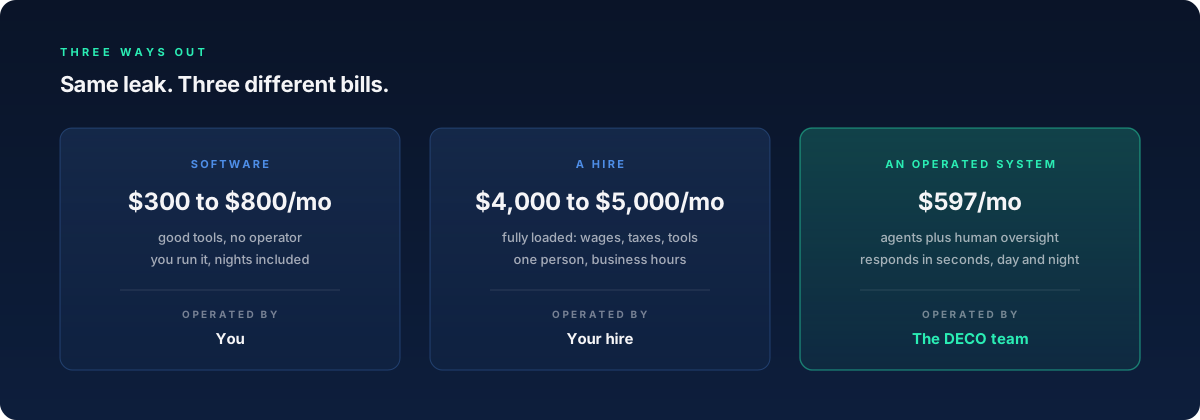
Put the three next to each other and the decision sharpens:
- Software: $300 to $800 a month, plus the unpriced line that decides everything: someone's hours, every week, to operate it.
- A hire: $4,000 to $5,000 a month fully loaded, plus the software stack they still need underneath them, minus coverage at night, on weekends, and during turnover.
- An operated system: $597 a month flat, agents plus human oversight, response in seconds at 2 PM and 2 AM alike, with field execution deliberately left to the field software that does it well.
None of those rows is wrong. They answer different questions.
How to decide in one afternoon
Three questions sort almost every business we audit into the right row.
Who, by name, will operate the tools? If you can name a person who has the hours and wants the job, software wins on price. If the honest answer is "me, at night," the stack will not get operated, and the subscription becomes a monthly fee for feeling like you fixed it.
Is the undone work judgment or repetition? Complex dispatch, escalations, and negotiation are judgment: hire for them. Speed, persistence, and consistency in follow-up are repetition: systems beat people at repetition every time, at a fraction of the loaded cost.
What happens to the lead that arrives at 7 PM on a Friday? If the answer is "nothing until Monday," a business-hours hire does not fix it, and software only fixes it if someone built, tested, and maintains the after-hours automation. This question alone settles most cases we see.
Whichever option you choose, choose it on the real numbers: the all-in software bill, the fully loaded hire, the flat operated fee, and the unpriced hours hiding inside each. The expensive option is not the software, the hire, or the system. It is another year of leads leaking while the decision waits.
Keep reading


Comparisons
Jobber vs HubSpot vs ServiceTitan vs GHL: which fits a $1-5M service business
10 min readThe DECO Team