
There is a dashboard mock-up on the home page of this site, built as a composite of the operations audits we run. Five tiles, five leaks. The four small ones get nods of recognition: fourteen missed calls with no follow-up, a four-hour average response time, twenty-three deals stuck in the pipeline, two quotes closed out of eighteen sent. The wide tile across the bottom is the one that makes owners go quiet. Reviews requested in the last thirty days: zero. Out of 47 completed jobs.
Forty-seven jobs is a solid month for a small crew. Forty-seven furnaces, panels, roofs, or yards finished well enough that the customer paid the invoice without a fight. And not one of those customers was asked to say so in public. That is the leak nobody budgets for, because it never shows up as a cost. No invoice goes unpaid. No ad dollar is visibly wasted. The month simply ends with the same review count it started with, while the competitor across town adds another handful.
What one review is actually worth
A review does two jobs, and both compound.
The first is rank. Google's own documentation on improving local ranking lists review count and review score among the signals that feed local results, alongside relevance, distance, and prominence, and states plainly that more reviews and positive ratings can improve a business's local position. That is Google's phrasing, not ours. For a home-service business, local rank is the whole game: the map pack is where the emergency searches land, and the map pack is where review signals bite hardest.
The second is conversion. When two contractors look identical on price and availability, the one with a steady stream of recent reviews beats the one whose newest review is over a year old, because a dormant profile reads as a business that might not pick up the phone. We will not invent a dollar figure for what a single review is worth, because it depends on your trade, your ticket size, and how crowded your market is. Directionally, though, the loop is simple: reviews lift rank, rank lifts profile views, views become calls at zero marginal ad cost, and unlike ads, the asset does not stop working when you stop paying.
There is a version of this math you can run tonight. Open your Google Business Profile, note your review count and the date of your newest review, then do the same for the three competitors who outrank you in the map pack. In most of the audits we run, the businesses sitting above our client do not have better work, better trucks, or better pricing. They have more recent reviews, asked for on purpose.
Which means every completed job is a unit of reputation inventory. Left unharvested, it expires.
Why owners do not ask
Three reasons come up in almost every audit, and none of them is laziness.
Asking feels awkward
The tech is at the door, the customer just paid, and asking for a public favor feels like begging for a tip. So it gets skipped just this once. Then the skip becomes the precedent, because nobody wants to be the one who makes the doorstep weird.
The window is short
A customer's enthusiasm peaks the day the work is finished and decays fast. By the time the owner remembers during Friday's admin block, the moment has passed, the ask feels stale, and the awkwardness doubles. So it gets skipped again, this time with a reason.
Memory is the system
There is no trigger. The ask depends on someone remembering, and the months with the most completed jobs are precisely the months with the least spare attention. The leak grows fastest when the business is doing its best work. That is why the tile reads zero out of 47 instead of 30 out of 47.
The review leak grows fastest in your best months. Every finished job you never ask about is reputation inventory that expires.
What a working cadence looks like
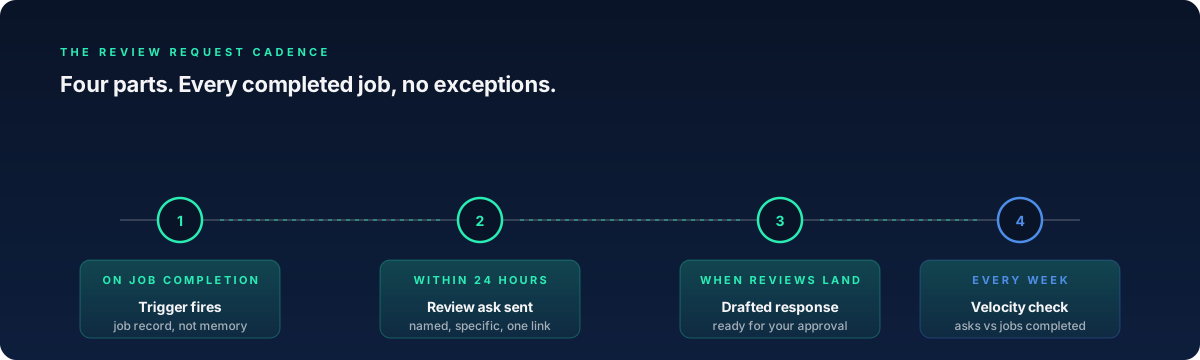
Four parts. None of them optional. And none of this is exotic technology: a trigger, a template, a draft, and a number somebody reads. The reason most operations do not have it is the same reason they have unanswered missed calls. It is nobody's job.
The trigger is the job record, not a person. The ask fires when the job is marked complete in whatever you run your schedule on. Nobody decides whether to ask, because deciding is where the leak lives.
The ask goes out within 24 hours, every job. Inside the window where the customer still feels the relief of a fixed problem. It names the customer, names the tech, references the actual work, and carries one link. SMS first, email behind it. And it goes to every customer, not a hand-picked happy subset: Google's review policies prohibit selectively soliciting positive reviews, so cherry-picking adds risk without adding stars. Send the ask; let the work decide the rating.
When a review lands, a drafted response is already waiting. The owner approves or edits in under a minute instead of writing from a blank box at 9 PM. Responding is not cosmetic: Google's guidance to business owners explicitly recommends responding to reviews to show that you value customers and their feedback. Negative reviews get a calm, factual draft the same day, which is exactly when you are least equipped to write one yourself.
A weekly velocity check closes the loop. Asks sent versus jobs completed should run one to one. Response rate gets read, misses get flagged, and the tile on the dashboard stops being a confession.
The part automation cannot do
An honest caveat belongs here. A review cadence does not manufacture reputation; it records it. The automation sends the ask, but the work earns the review. If callbacks are slow, punch lists drag, and trucks show up late, a working request system will document all of that at scale and in public. We have told more than one prospective client to fix their service recovery before switching the cadence on. The system only decides whether your reputation gets written down. The crew decides what it says.
Podium is good at this. That is not the question.
The tool people usually buy for reviews is Podium, and credit where it is due: review management is Podium's heritage and core competence. Text-first review invites, monitoring across more than a hundred sites, a genuinely polished inbox. G2 users rate it 4.6 out of 5. If you are evaluating it, our full Podium comparison walks through the reported pricing: Core at a reported $399 per month for one location on an annual contract, with AI add-ons quoted separately, per a third-party pricing teardown published in January 2026.
The question is not whether a tool can send review requests. Jobber and Housecall Pro can do that too. The question is who operates the program. Someone writes the templates, watches the inbox, drafts the responses, reads the velocity number every week, and notices when the cadence quietly breaks. If the answer is the owner in spare time, the original problem has been recreated one level up: the ask now depends on someone remembering to operate the asking machine.
That is the difference in how we build it. Reputation is one pillar of the system DECO installs: the post-job request flow, monitoring, drafted responses ready for approval, and the weekly numbers, operated by our team instead of added to your week.
One tile out of five
The review tile sits across the bottom of that dashboard for a reason. The other four leaks cost you this month's revenue; this one costs you next year's rank, and it compounds in silence either way. If you are triaging, start with the leak that decays in minutes, the missed call, since speed there pays back immediately. But do not let the quiet leak keep running while you fix the loud one. Forty-seven finished jobs is forty-seven asks. The month that tile reads 47 out of 47, the flywheel starts spinning for you instead of for the competitor across town.
Keep reading


Comparisons
Jobber vs HubSpot vs ServiceTitan vs GHL: which fits a $1-5M service business
10 min readThe DECO Team