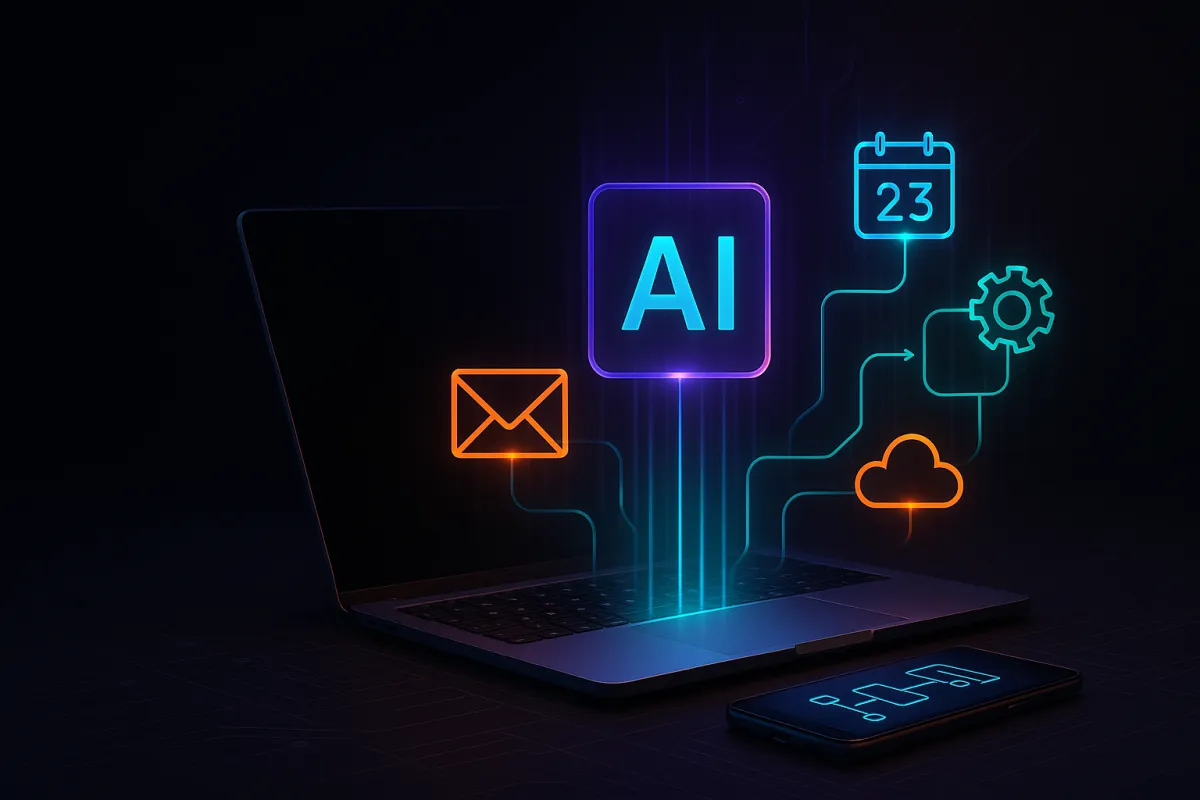
AI Integration Into Everyday Business Tools: How SMBs Can Level Up with Generative AI, Cloud Systems, and Workflow Automation
Still Treating AI Like a Separate Tool? Here's Why That's Costing You Time and Money.
If you are a small service business owner, you have probably experimented with AI at some point — maybe typing prompts into a chatbot, copy-pasting results into your documents, then manually sending them off. Sound familiar?
That workflow is already outdated.
In 2026, the most successful service businesses are not using AI as a separate tool — they are using AI that is built directly into the software they already rely on every day. And if you have not made that shift yet, you are leaving real time, money, and competitive advantage on the table.
In this post, you will discover exactly how generative AI, cloud systems, and automated workflows are transforming everyday business tools — and the practical steps you can take to implement them in your service business starting today.
Why AI Is No Longer a Big Business Thing
For years, the narrative was that AI was reserved for enterprise companies with large tech budgets and dedicated development teams. That story is over.
Today, 60% of small business operations are already using AI — double the number from just 2023. More than half of SMBs (53%) are already using AI and another 29% plan to start by 2026, with most pointing to faster growth and measurable ROI within the first year.
The shift is seismic — small businesses have gone from nervously experimenting with chatbots to weaving AI into every department — from customer communications to invoicing, scheduling, and content creation.
The question is no longer whether your business should use AI. The question is: are you using it where it actually matters?
What AI Built Into Your Tools Actually Means
A few years ago, integrating AI meant opening a chatbot in one tab, typing a prompt, copying the output, and pasting it somewhere else. That was a starting point — but it was inefficient, disconnected, and easy to abandon.
What is happening now is fundamentally different. AI is being embedded directly into the software you already live in. Here is what that looks like in practice:
- Your CRM automatically drafts follow-up messages after a lead fills out a form and sends them without you lifting a finger.
- Your email client generates reply drafts based on the context of the conversation.
- Your project management platform converts meeting notes into assigned tasks with due dates.
- Your accounting software automatically categorizes expenses, flags irregularities, and prepares invoice summaries.
- Your scheduling tool intelligently books appointments, sends reminders, and reschedules when conflicts arise.
- Your customer support system handles up to 70% of routine inquiries through AI chatbots, available 24/7 without adding headcount.
This is not futuristic. This is happening right now, inside tools that small service businesses use daily.
The 5 Everyday Tools Where AI Makes the Biggest Impact
1. CRM and Client Management
Your CRM is the heartbeat of your service business. When AI is built into it, it does not just store contact information — it tells you what to do with each contact. AI analyzes customer information to create personalized marketing campaigns, surfaces the most relevant next action for each lead, and automates follow-up sequences without manual input.
Real result: Less time managing your pipeline. More time closing and delivering great work.
2. Email and Communication
Drafting individual emails is one of the biggest time drains for service business owners. AI-powered email tools generate contextual draft replies, suggest subject lines, flag important messages, and even identify which leads need a follow-up before you have had a chance to notice.
Real result: Save 30 to 60 minutes per day on inbox management alone.
3. Scheduling and Calendar Automation
Eliminate the endless back-and-forth of appointment booking. AI scheduling tools learn your availability preferences, automatically send confirmations and reminders, and handle rescheduling logic — all integrated directly into your existing calendar system.
Real result: Zero no-shows and zero manual scheduling friction.
4. Cloud-Based Operations and File Management
Cloud platforms let your team scale up or down quickly, adapting to spikes in demand without on-premises infrastructure costs. When employees can access files and workflow tools securely from any device, productivity no longer depends on where the team sits. AI layers on top of this by organizing documents, summarizing files, and automatically routing information to the right people.
Real result: A leaner, more flexible, location-independent operation.
5. Workflow Automation Platforms
This is where the real magic happens. Modern workflow automation platforms now let you describe what you want in plain language — no coding required. For example: When someone fills out our contact form, add them to my CRM, send a welcome email, assign to the right team member, and schedule a follow-up in 3 days. The AI handles the execution. You just approve.
Real result: Complex, multi-step processes run automatically 24/7 without your involvement.
The Real Numbers: What AI Integration Actually Saves You
- 91% of SMBs using AI report a boost in revenue — and growing businesses are nearly twice as likely to invest in AI compared to those in decline.
- 84% of leaders believe AI has had a positive effect on their productivity.
- Productivity tools can save your team 10+ hours per week — that is more than 40 hours a month, essentially a full work week back in your hands every single month.
- Small businesses have increased their AI investment by 58% in the past two years — because the results are undeniable.
A good AI-integrated tool stack costs a fraction of what even a part-time employee would cost — while delivering results around the clock.
A Practical 3-Step Framework to Start Today
Step 1: Audit Your Repetitive Tasks
List three to five tasks your team does every single week that require little creative thinking — sending appointment reminders, following up on leads, categorizing expenses, responding to common questions. These are your automation targets.
Step 2: Check What Is Already in Your Current Tools
Before purchasing anything new, ask: what AI features are already included in the tools I am paying for? Many platforms have already rolled out AI capabilities that most users have never turned on. Commit to a two-week pilot and measure the impact.
Step 3: Start Small, Build Confidence, Then Scale
Pick one low-risk process — like sending follow-up confirmations after a booking — and automate it fully. Build it, test it with a small group, adjust it, then move to the next. Most automations can be set up in an afternoon. Once you see the time you get back, you will never stop.
The Bottom Line for Small Service Businesses
It is not about gadgets or buzzwords anymore. It is about getting more done with less stress, without adding to your payroll.
The service businesses winning in 2026 are not the ones with the biggest teams or budgets. They are the ones who figured out how to use the tools they already have — smarter, faster, and with AI doing the heavy lifting in the background.
The best technology is not the flashiest. It is the tech that actually supports your people, protects your data, and aligns with your goals.
At DECO, we help small service businesses build the systems and automation strategies that free up your time and scale your growth — without the overwhelm.
Ready to see what AI-powered systems could look like in your business? Book a Free Strategy Call with DECO Today.